

Date:
2026 November 5
Category:
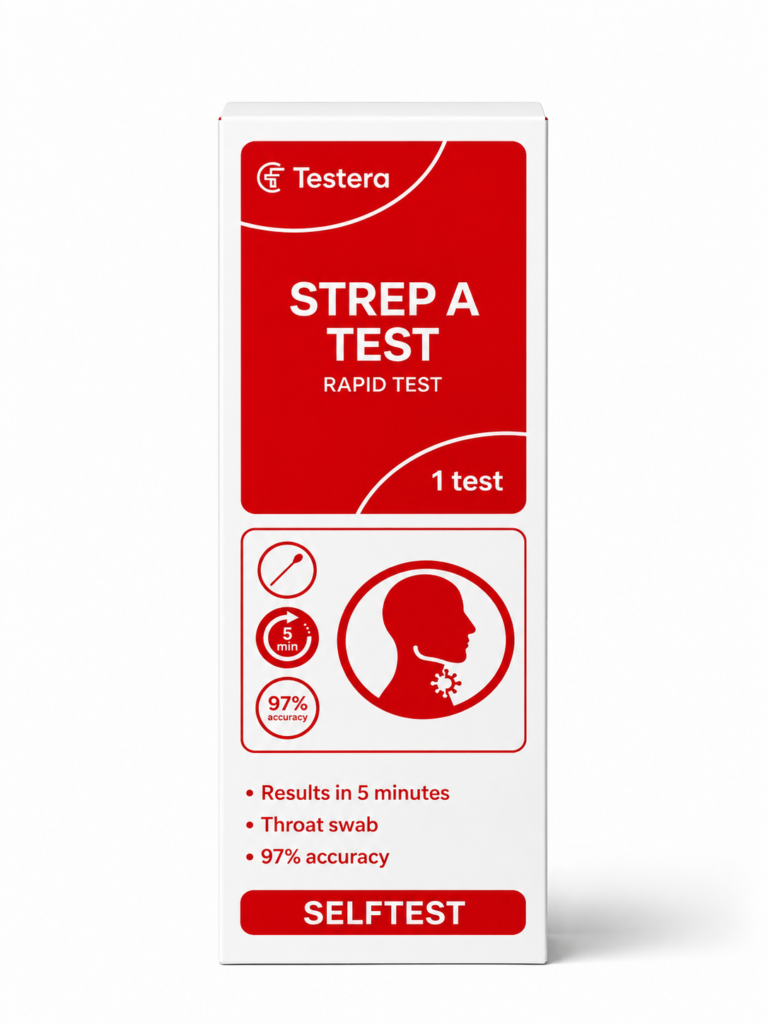
Strep A Self-Test (throat swab)
The test is intended for the qualitative detection of Group A Streptococcus antigens in a self-collected throat swab sample. For self-testing at home.
About the condition
Group A Streptococcus is the most common cause of bacterial throat infection (pharyngitis, tonsillitis). The infection can cause a severe sore throat, red and swollen tonsils, fever, swollen neck lymph nodes, headache, nausea or vomiting, especially in children.
Most cases of sore throat are viral and do not require antibiotics, whereas Group A Streptococcus infection is treated with antibiotics prescribed by a doctor. These infections are difficult to tell apart by symptoms alone, and a traditional throat culture takes 24–48 hours or longer. The rapid test helps determine within 5 minutes whether the sore throat may be caused by Group A Streptococcus, so that you can consult a doctor in time.
Ingredients
- Test cassette (in foil pouch)
- Sterilus tamponas
- Buffer 1 (ampoule, 0.24 ml)
- Buffer 2 (tube, 0.16 ml)
- Instructions for use
Instructions
- Allow the test cassette and buffers to reach room temperature (15–30 °C) before testing.
- Wash and dry your hands thoroughly. Check the kit contents and expiry date.
- Remove the cap from the Buffer 2 tube and place the tube in the marked circle on the box or in the tube holder.
- Snap off the tip of the Buffer 1 ampoule at its narrowest point and pour the entire solution into the Buffer 2 tube. Use the mixed solution immediately. Keep Buffer 1 in its black pouch until use.
- Tear open the package and take out the sterile swab. Do not touch the soft tip.
- Stand in front of a mirror, tilt your head slightly back and open your mouth as wide as possible. Press down your tongue with the tongue depressor or a spoon.
- Rub the swab tip over the surface of one or both tonsils or the back wall of the throat. When withdrawing the swab, avoid touching the tongue, cheeks and teeth.
- Immediately insert the swab into the tube with the buffer mixture and rotate it about 15 times in different directions. Leave the swab in the tube for 1 minute.
- Remove the swab while pressing its head against the inside wall of the tube to release as much liquid as possible. Screw on the tube cap.
- Remove the test cassette from the foil pouch and place it on a flat, horizontal surface. Invert the tube and add 3 drops of the solution into the sample well (S). If the drop contains air bubbles, add one more drop.
- Read the results after 5 minutes. Do not interpret results after 10 minutes. Do not move the cassette while waiting.
Results
Positive result:
Two colored lines appear: one in the control region (C) and one in the test region (T).
Negative result:
Only one colored line appears in the control region (C); no line appears in the test region (T). Strep A antigen was not detected in the sample or its amount is too low to be detected. If symptoms persist, consult a doctor; the test may be repeated after 1–2 days.
Negaliojantis:
The control line (C) does not appear. An incorrectly performed procedure or a damaged test are the most likely reasons. Repeat the test using a new test.
Instruction leaflet
Download instructions






Frequently asked questions
When should I take a Strep A test?
When you have a sudden sore throat, fever and red or swollen tonsils without cough or runny nose. Take the test before starting any antibiotics.
How does the self-test differ from the professional Strep A test?
The self-test is designed for home use: the kit contains everything you need and instructions for lay users. The professional test is intended for clinics and is performed by a healthcare professional.
Does a negative result mean there is no infection?
Not always. If symptoms persist or get worse, consult a doctor – the test can be repeated after 1–2 days.
Where to buy the Testera test?
Testera tests are sold in pharmacies, retail chains, and petrol stations in several European countries. Want to sell Testera products in your country? Contact us – we will offer terms of cooperation.
Rapid tests are for preliminary screening and do not replace a doctor’s consultation.