

Date:
June 12, 2024
Category:
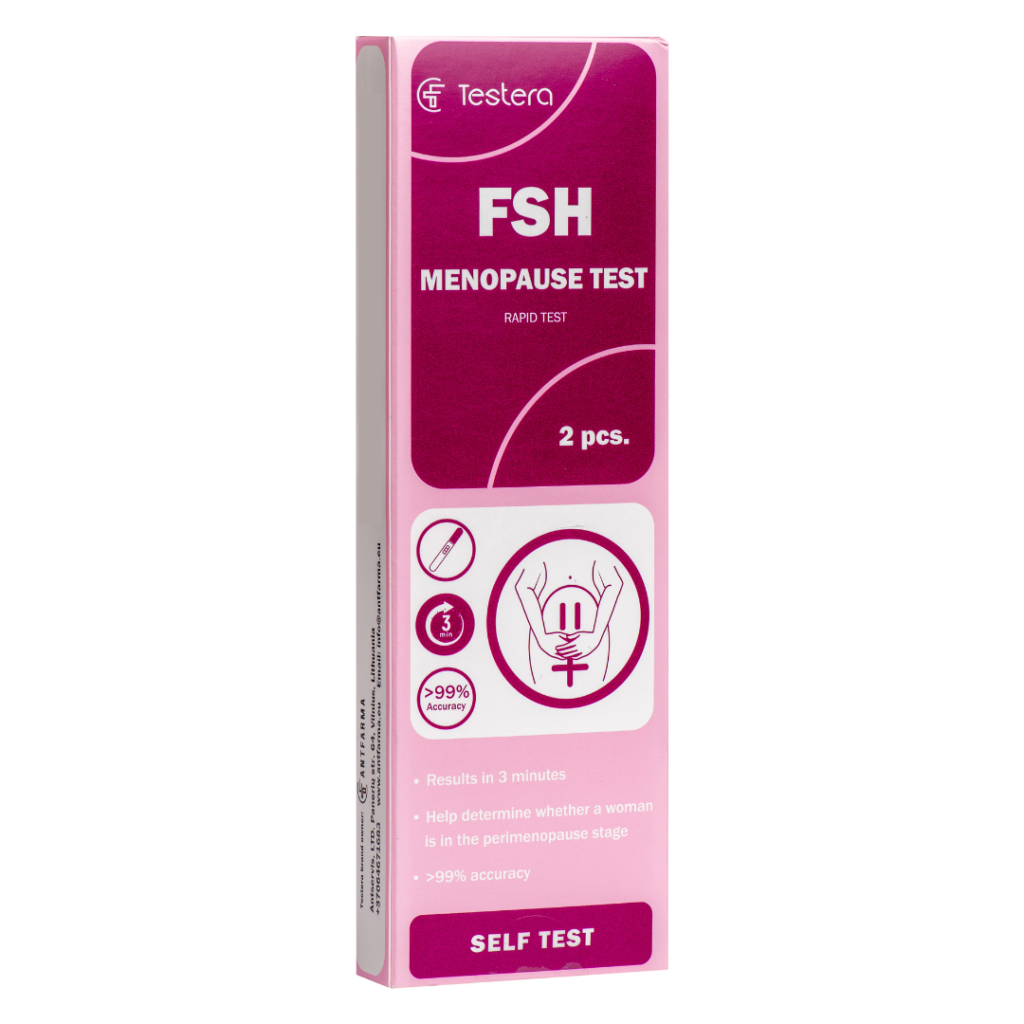
Menopause (FSH) test
A rapid test designed to detect elevated levels of follicle-stimulating hormone (FSH) in urine, helping to evaluate whether symptoms may be related to perimenopause or menopause. The test is not intended for assessing fertility or for contraception.
About the condition
Menopause is a natural stage when menstruation ceases; it usually occurs around ages 45–55, and is preceded by perimenopause, which lasts for several years. As ovarian follicle reserves become depleted, estrogen production decreases, causing the pituitary gland to produce more follicle-stimulating hormone (FSH). Due to hormonal changes, irregular periods, hot flashes, night sweats, sleep disturbances, mood swings, and vaginal dryness may occur. The test helps assess whether the symptoms may be related to perimenopause or menopause; since FSH levels fluctuate during this period, it is worth discussing the result with a doctor, especially if symptoms started before age 45.
Ingredients
- Midstream tests
- Package leaflet
Instructions
Wait until the urine sample has cooled to room temperature (15-30 °C) before testing.
- Set a day to take the test. (See section WHEN TO START TESTING).
- Keep the bag at room temperature before opening it. Remove the test from the sealed bag and use it within one hour.
- Remove the cap from the dipstick test and hold the test so that the urine stream flows over the absorbent tip, or dip the absorbent tip in
(about 2/3) into a urine sample taken in a clean container and hold for at least 10-15 seconds. - Put the cover on the current test and place the test on a flat and stable surface (the test and control box must face upwards).
Switch on the timer immediately. - Once the test has started, you may notice a light-coloured flow moving in the test and control window. Check the result after 3 minutes. Do not check the results after 10 min.
Results
| Positive | Two lines are visible and the line in the test line area (T) is the same as or darker than the line in the control line area (C). A positive result means that the FSH level is higher than the normal level. Write down the result and refer to the table below to interpret the results. |
| Negative | Two lines are visible, but the line in the test line area (T) is lighter than the line in the control line area (C) or there is no line at all in the test line area (T). A negative result means that the FSH level has not risen. Write down the result and refer to the table below to interpret the results. |
| Not valid | The control line does not appear. The most likely reasons for the non-appearance of the reference line are insufficient sample quantity or an incorrect procedure. Revise the procedure and repeat the test using a new test. If the problem persists, stop using the test kit and contact your local distributor. |
Instruction leaflet
Download instructions




Frequently asked questions
What are the symptoms of menopause?
The most common are irregular periods, hot flashes, night sweats, sleep disturbances, and mood swings. Menopause usually begins between the ages of 45 and 55.
How does a menopause test work?
The test detects elevated levels of follicle-stimulating hormone (FSH) in the urine. Since FSH fluctuates, it is recommended to repeat the test according to the instructions.
Does a positive test mean that getting pregnant is no longer possible?
No, it is still possible to get pregnant during perimenopause. Consult a gynecologist regarding contraception and symptom management.
Where to buy the Testera test?
Testera tests are sold in pharmacies, retail chains, and petrol stations in several European countries. Want to sell Testera products in your country? Contact us – we will offer terms of cooperation.
Rapid tests are for preliminary screening and do not replace a doctor’s consultation.