

Date:
June 12, 2024
Category:
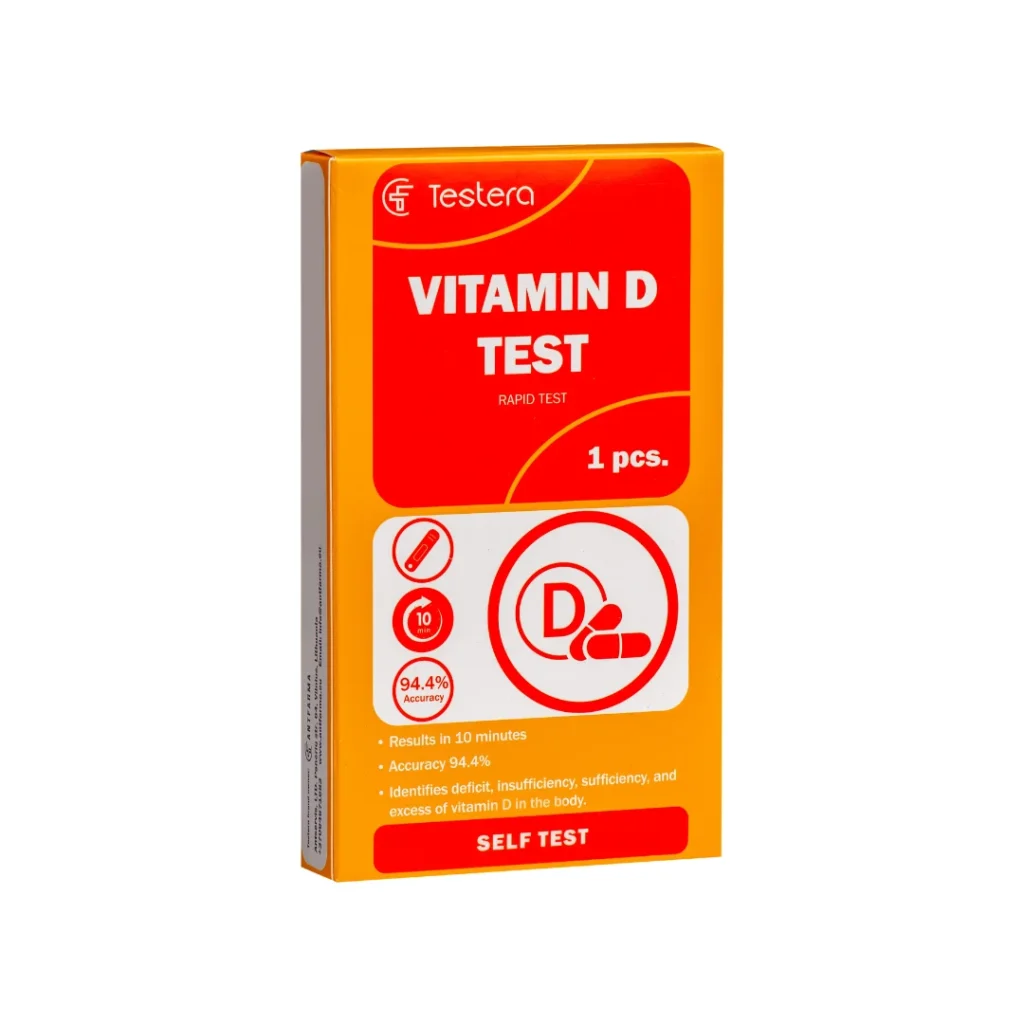
Vitamin D Rapid Test (blood)
Rapid test for assessing blood vitamin D (25(OH)D) levels and classifying the result into deficiency, insufficiency, sufficiency, or excess categories.
Contact our sales team for availability and delivery time
Where to buy →Testera on testera.eu – find a pharmacy or shop near you
About the condition
Vitamin D helps the body absorb calcium and phosphorus, making it important for bones, muscles, and teeth. In Northern and Central Europe, due to insufficient sunlight from autumn to spring, its deficiency is common; a deficiency may not cause symptoms for a long time, and later manifest as fatigue, bone or muscle pain, and weakness. Higher risk groups include older people, those who spend little time outdoors, people with darker skin, overweight individuals, pregnant women, and those with intestinal diseases. The test helps assess vitamin D status and, if necessary, consult a doctor or pharmacist regarding supplement dosage; excess is usually associated with excessively high supplement doses.
Ingredients
- Test cassette
- Buffer
- Lancet
- Alcohol-soaked swab
- Capillary dripper
- Package leaflet
- Colour card
Instructions
- Wash your hands with soap and rinse with clean warm water.
- Keep the bag at room temperature before opening it. Open the bag, remove the test cartridge and place it on a clean and flat surface. Perform the test within one hour, but best results are obtained if the test is performed immediately after opening the foil bag. Remove the dropper, the buffer bottle, the lancet and the alcohol-soaked swab and place them near the test cassette.
- Carefully detach and discard the detached lancet cap.
- Clean the tip of your middle or ring finger with an alcohol swab to prepare the puncture site. Let it dry.
- Press the lancet on the side from which the cap was removed; after use, the tip automatically and safely retracts. Massage the hand toward the tip of the middle or ring finger intended for puncture, without touching the puncture site.
- Keeping your arm lowered, massage the pierced fingertip to make a drop of blood appear. Wipe off the first drop of blood.
- Without squeezing the head of the capillary dropper, touch it to the expressed blood. Due to capillarity, the blood enters the capillary dropper up to the line indicated on the capillary dropper. If the blood does not reach the indicated line, you can massage the finger again to express more blood. Avoid air bubbles.
- Squeeze the head of the dropper to transfer the blood into the sample well (S) of the cartridge.
- Wait until all the blood has dripped into the well. Unscrew the cap of the buffer bottle and add 2 drops of buffer into the well of the cartridge buffer (B), then start the timer.
- Wait for the coloured line(s) to appear. Check the results after 10 minutes. Compare the intensity of the T-line with the "Vitamin D Colour Card" provided with the kit to determine the level of vitamin D in your blood. Do not check the results after 20 min.
Results
| 25-OH vitamin D levels | Reference range (nmol/L) | Reference range (nmol/L) | To read the results, see the Vitamin D Color Card |
| Deficiency | 0-10 | 0-25 | Two coloured lines appear. One appears in the control area (C) and the other must be in the test area (T). The intensity of the line in the test area (T) is equal to the deficiency (0-10 ng/mL) on the colour card, indicating that the vitamin D level is deficient. |
| Insufficient | 10-30 | 25-75 | Two coloured lines appear. One appears in the control area (C) and the other should be in the test area 25-75 (T).The intensity of the line in the test area (T) is equal to the sufficient line (10-30 ng/mL) on the colour card, indicating that the vitamin D level is not sufficient. |
| Sufficient | 30-100 | 75-250 | Two coloured lines appear, one should always be in the control area (C) and a faint coloured line appears in the test area (T).The intensity of the line in the test area (T) is equal to the sufficient line (30-100 ng/mL) on the colour card, indicating that the vitamin D level is sufficient. |
| Excess | A single coloured line appears in the control area (C). No coloured line is visible in the test line area (T). If the result shows an excess, it is recommended to consult a doctor. |
| INVALID | The control line does not appear. The most likely reasons for the non-appearance of the reference line are insufficient sample quantity or an incorrect procedure. Revise the procedure and repeat the test with a new test. If the problem persists, stop using the test kit and contact your local distributor. |
Informative video
Instruction leaflet
Download instructions





Frequently asked questions
What are the symptoms of vitamin D deficiency?
Most commonly mentioned are fatigue, muscle weakness or pain, more frequent colds, and a poor mood, especially in autumn and winter. The symptoms are non-specific, so a test is the most reliable way to show a deficiency.
How is the vitamin D test performed at home?
The finger is pricked with a lancet, a drop of blood is placed on the test cassette, buffer solution is added, and after the specified time, the result is read based on the control and test lines. The exact procedure is described in the package insert.
What to do if the test shows a vitamin D deficiency?
The rapid test is indicative. Consult your doctor or pharmacist regarding the dosage of vitamin D supplements and further tests.
Where to buy the Testera test?
Testera tests are sold in pharmacies, retail chains, and petrol stations in several European countries. Want to sell Testera products in your country? Contact us – we will offer terms of cooperation.
Rapid tests are for preliminary screening and do not replace a doctor’s consultation.